Showing posts with label urban living. Show all posts

January 13, 2009

Mini Greywater

I ran across these kits the other day when I got distracted in my job hunting.


You can attach them to your existing plumbing and divert the water to flush your toilet. The great thing about these is that they are so simple. You don't have to go through some massive ordeal to reconfigure your plumbing - it just installs in your bathroom.

The downside - these kits run over $400, and the estimated savings is only about $25 annually. The other potentially fatal flaw; they're hideous. I don't know how many people will install them under their Kohler pedestal sink. Maybe in an enclosed vanity . . .

check it out here:www.watersavertech.com

January 09, 2009

Tata Nano, the $2500 micromobile


Its teeny, its cheap, it gets 50mpg, its $2500, its the Tata Nano.

Yes, it still takes fossil fuels to make this baby go. But for everyone buying gas guzzling, fume emitting cars, this is a great option...Right now its only available in India, so stay tuned.

Its small scale relates to our massive auto population, bigger is bye bye and smaller gives the roadways a chance to breath and for the auto scape to not be (so) imposing (if that is possible). So for anyone that is going to buy a cheap beater that won't get good mileage and will off gas a ton, this is your option!

Its just what the doctor ordered in the name of personal transportation.

Sidenote: I am also seeing an emergence of 100% electric cars (think Tesla). Even though this is a fossil fuel source too, you can purchase alternative energy to charge your vehicle. This is the way I hope to go in the future, if I ever buy a car. As a whole, we need to keep telling the government we want more alternative energy sources, like wind power, for our homes.

But lets not forget about the beautiful bicycle and public transportation. They should be our first go-to modes of transportation. The more we support them, the more their networks will grow and the easier they will be to use for everyone.

December 21, 2008

Chickens are in this year . . .

In Northern California, backyard chickens are the latest accessory. They have by far surpassed the Prius in popularity contests among the eco-conscious housewife set. They make an amusing addition to the household. Happy chickens will give you an egg a day once they are mature. Another benefit - you can feed them all of your veggie table scraps and use the chicken poop for your compost. What a time saver!

Actually, backyard chickens have been around here since the last wave of planet savers came through in the seventies. Here's an article from the la times about a local flock that is creating havoc: http://www.latimes.com/news/local/traffic/la-me-chickens8-2008dec08,0,6832003.story.

I have run across these fellas a few times myself. They're just a few miles away. I find it refreshing when a chicken stops traffic - even if I am in a hurry.

gisele

December 15, 2008

City Chickens: eggs a la backyard


Some friends and I have been dreaming about having chickens in our backyard for some time now. Can you just picture waking up on a Saturday morning, having a piping cup of coffee and reading the BBC, and then going out back, 10 feet from your door to harvest some eggs, go inside crack them in a pan and golden sunny side up eggs completes the morning. Eggs fresh from the backyard, you know where they came from, you know what the chickens eat and they are so delicious its like wandering through a Haruki Murakami novel in your mouth?


Well, you can legally keep chickens in your backyard in Chicago. Currently there is no blog or website that shows this, but you can attend a class near the city to show you how to care for your new lovelies. And check out this blogger from California that has been following this movement.


Seeing the local agriculture movement break into the city scape is not only giving us some edible landscaping and beauty, but is allowing us to appreciate how our food gets to us from farm, or backyard, to plate.

October 31, 2008

CSA Boxes, support your local farmer!

CSA: Community Supported Agriculture
What is it? In Chicago I use freshpicks to deliver a full box of fresh fruits and veggies from various local farms to me, every other week. Its chock full of amazing goodies, and they usually add in one or two small surprises (one week it was wild mushrooms, another homemade spaghetti sauce!)

Why is it good? You are supporting local farmers, you will be eating in season good, because its local, you will be able to experiement with fruits and vegetables you wouldn't normally pick up at the supermarket, and be able to spout off a jillion ideas for a parsnip to your friends.

What does it cost? Well, through freshpicks, you can determine the portion of food: and its $25 or $40 dollars...or you can shop through their (reasonably priced) offerings and make your own box! Deliver is an extra $5, not bad!

Perks? You can specify no dairy, no carrots, or only food from Illinois. They work with you to get you exactly what you want.
Last week I went and visited one of their large suppliers of milk: Traders Point Creamery, and there will be more on the excursion soon!

Go to Local Harvest to find a CSA near you.

October 28, 2008

Save Those Nutrients!


This week while you’re walking around the city enjoying the crisp fall air and delighting at the leaves tumbling down the street, take a moment to think ahead to next year. Instead of letting the street sweeper brush them all away, capture the nutrients of those fall colors for your garden next spring. A leaf compost pile is one of the simplest composts you can do. All it takes it the right container, those pretty crinkled leaves, a little activator, and time.

You can buy a compost bin at just about any mega-improvement store these days, but they are a little pricey for what is fundamentally a dirt holder. Instead, try making your own from salvaged or simple materials. I made this one from 10’ of chicken wire, 6 twist ties, and four metal stakes. It took me about twenty minutes to build – the biggest chunk of time going to hammering in the stakes. You can also try using an old garbage can, palettes, etc. My mom made a beautiful compost bin a couple years ago out of sticks woven into a huge basket. It also doubles as an art piece.

Here are the steps to start your spring garden compost:
1. Build an aerated “container”
2. Put down a layer that will allow air to circulate around your compost. I used sticks. You could also use a couple boards, spaced out bricks, etc.
3. Add leaves
4. Water them down
5. Add a heating agent like manure or bone meal
6. Repeat

Leaf composting is a great way to live locally and keep a little extra out of the landfill. Without food waste your compost should stay rat free. Have fun and happy Fall!

October 19, 2008

Canning Tomatoes: a beginners how to

I have finally gotten  over the scary hump of canning tomatoes, and just did it.  Very rewarding I must say!  I wanted to do this so I could still be eating local produce (as much as possible) through the winter.  Canning is an excellent way to support your local farmers and have their nutricious foods preserved for your winter 
fare.  *I do not have a camera right now, so the following pictures were taken with my computer, and aren't the most amazing.  My apologies!  Many folks who can regularly have canning equipment: I do not.  So don't be afraid to try to use what you already have!  First, go to your farmers market, garden or store and get your tomatoes!  Today I used 10 lbs of beefsteak tomatoes from a farm in Michigan.  They were only 2 dollars a pound too, which is fantastic.

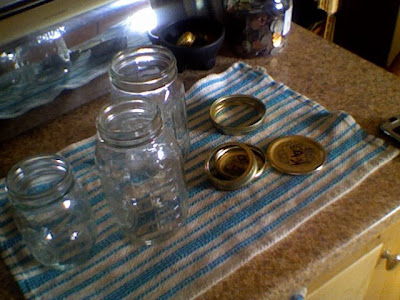
Step 1: Santize your jars.  I used a mixture of what I had lying around: wide and narrow mouthed mason jars.  My jars have a lid and a ring that you use to seal the jar.  Santize by either placing in dishwasher or a large pot of boiling water for 5 minutes.

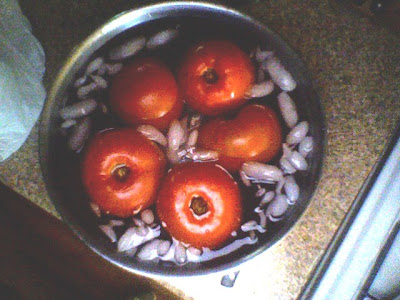
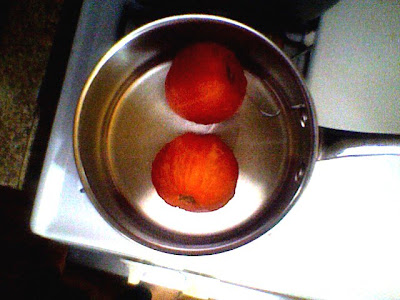
Step 2: Boil a large pot of water for de-skinning the tomatoes.  When the water is boiling submerge the tomatoes until you see their skin crack.  (My beefsteaks boiled for about 5 minutes before their skins broke).  
When the tomatoes skin is broken, place them in an ice bath, so they can cool down for you to peel them.  When they are cool enough you should be able to pull the skins right off.
The peeled tomatoes can either be cut into chunks or pured.  I prefer to do halved tomatoes in my larger jars; find they are more versatile this way. 
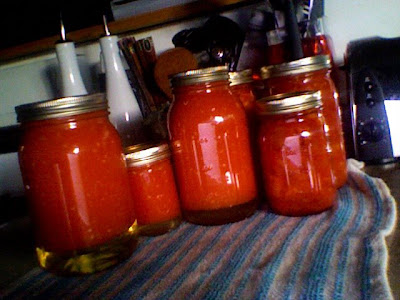
Now fill your jars within 1/4" of the top, make sure the top is clean (you can wipe with a paper towel or clean rag) put a tablespoon of salt in a large jars and a teaspoon in the small ones.  Place the lids on the jars and you are going to boil the jars standing up in a very large pot of water.  The tops of the jars need to be submerged.  Some people do this from 5 - 40 minutes.  I do it until the top is popped in (so when you press down it does not click any more, you might even hear a POP! while its in the water bath.)  If the top hasn't popped by 40 minutes, you take take it out and it should pop in a few hours.  This made 3 large & 1 small jar of diced tomatoes AND 1 large and 1 small jar of tomato puree.